Blog

  • Measuring the QRPp’s Isn’t Easy

    SWR Detectors
    SWR Detectors

    Interesting how a development in one area of this hobby can force a sudden change of direction to explore some new areas. I’ve been happily experimenting with my Hans Summers Ultimate 3S kit when I realised that I could band-hop and get a picture of propagation conditions updated every 30 minutes or so. Cool idea.

    But band-hopping requires a multiband antenna. Alternatively a tuner or something to adjust the U3S (which has quite a robust albeit low power output) to the piece of wet string hanging out the window. Even then, one may never know exactly how well you are getting out, and therefore whether your propagation forecast is accurate.

    Thus the sudden change in direction: I want to measure exactly how much RF is going down the cable to the antenna. This should be easy, right? A quick search on Google brings up dozens of very good kits and circuits, and I dive headlong into the challenge. That was a few weeks ago already. And I learnt a painful lesson: There are not a lot of options available for the QRPp operator.

    Let me be honest, many of the circuits and kits I saw were designed for the American market where they must handle kilowatts with a minimum scale of 100 watts. But when you start talking in the milliwatt region there is a big void. I spent hours and hours winding toroids, soldering up detector boards, wasting tons of paper taking meticulous readings, all in the 5 watts plus region. But I couldn’t get things to work in the 150mW and less region where the Ultimate 3S is working.

    So here is the challenge: Does anybody have a working circuit or plan for a QRPp SWR / Power meter? Drop me an email and I can share some of the ideas I have already tried, but I’m desperate for some new ideas.

    73s de Leon ZR6LU from Johannesburg 0825735580

  • Ultimate 3 S – part 2 – drifting a bit

    U3s WSPR drifting
    U3s WSPR drifting

    I let the U3s run last night with the first LPF relay board installed (6 bands only) and hopping in sequence from 80m to 10m just to see what can happen. I’m still learning the device, she is not a trivial little kit! I added a CW ID as the last transmission.

    Anyways to my surprise two major discoveries: The single output transistor is not overheating – thats gotta be good. And then some spotters uploaded my callsign! This is amazing because the bands were a little bad. To see my signal going as far as 8000km on only 200mW (I didn’t actually measure the 200mW, I’m just assuming) is a great accomplishment.

    The little worry is that it appears to drift a little on 10m, only 3 Hz or so, but still … I wanted to put up a 2m beacon sometime and the drift is not good. Mind you, I haven’t done anything to stop it, there are some hint’s on Hans Summers’ blog site.

    Meanwhile, maybe it is time to build the OCXO (Oven Controlled Crystal Oscillator) and see if that brings an improvement.

  • Ultimate 3 S – part 1

    Ultimate 3 S
    Ultimate 3 S

    My latest baby! I will write the full story in a few installments, from the back to the front so to speak, in other words I’ll show you the final result first before going back and showing pictures of the construction and so on.

    Of course I’m talking about my Hans Summers Ultimate 3S beacon transmitter.

    She came to me via the UK, where Ken Murdoch put it into his luggage and transported it to me in the far south over the December 2015 holiday period. Thus we avoided any issues with the South African Post Office who is notorious for “losing” packages.

    After some construction time, not a lot I might add, she lit up her lights and started WSPR-ing sweet tones to the world. ZS6USA was the first to respond.

    It is possibly the best kit I’ve ever built and the sweetest performer I can remember.

    Watch out for part two.

  • WSPRing is addictive

    WSPR on 2m
    WSPR on 2m
    Like the mermaid calling the sailor, this mode called WSPR seems to be calling me back every time. Circumstances pushed me out of the house into my new outside semi-underground shack which made me QRT for a while while I was painting and renovating, but the first thing I did (after making the few compulsary voice contacts on 40m) was to set up my WSPR station again.

    But this time it came with a different urgency. After getting the basics right and decoding a few stations on 10m (wow the bands are lively!) I tried 6m. My antenna isn’t very good but what the heck the Flex-1500 can go there. No decodes. Can it go higher? Nope, that is the highest frequency the Flex will do.

    Thus out comes the old trusty Yaesu FT-857D, still a remarkable and reliable radio after so many years, a true benchmark model to compare against. The G4ZLP modem is also the best money I ever spent for first-time-lucky set-ups. But oh dear, nobody on 6m (lots on 10m), so we tune up to 2 meters on a nice vertical. Still no decides, sigh. After reading a bit more, it seems like not a lot of people are WSPRing on 2m and so I posted in the SARL forum as well for some help. Tropo ducting is rife at the coast and my always-opportunistic self decides to make 2m a priority.

    As of this morning my station is QRV on 144.489MHz (dial setting) and I’m in and out of the shack doing chores while thinking about the next step. I’m going to have to wake-up shake-up some rusty old hams to participate otherwise I’ll get no spots. I’ll keep you posted.

    P.S. the upshot of this all is that I spoke to the minister of home affairs about how far we can bend the budget and she agreed that we have enough to buy one of Hans Summers’ Ultimate U3S QRP kits. I’m so excited I can eat raw popcorn!

  • Falklands is a mere WSPR away

    WSPR to Falklands
    WSPR to Falklands

    The last thing I did last night was to make peace between my laptop, my Flex-1500 SDR, and the various VAC and VSP drivers and whatever else was struggling to co-exist in the apparently too small memory of my Windows 7 computer.

    So can you imagine the delightful surprise I got this morning: I switched everything on and went to make coffee and shower. A little bit later I went to check on my WSPR installation, and this is what I saw on the log:

    2015-06-08 05:12 VP8ALJ 3.594094 -19 0 GD18bh 10 ZR6LU KG43 7517 105

    I’m very pleased, because my antenna is not really made for 80m (it’s actually a 40m travelling wave Broadgun) and I wasn’t expecting any spots yet. But there it is, and more than once. Nice spot!

    This is what makes this hobby so great, these little achievements.

  • Flex-1500 – Starting the SDR journey

    Flex-1500 SDR
    Flex-1500 SDR
    I might be older, but I’m very young at heart when it comes to technology. I love playing with all the latest gadgets and adopting my hobby to the emerging technologies. One example would be that I only run solid-state amplifiers (watch out for my series of articles on building my own). I also talk WSPR and digital modes fluently.

    So it would come as no surprise that I tested one of the RTL-2832 USB adapters to see what I could see. And I saw the incredible power of the panadapter display and waterfall combined, and I started thinking. I had to think, because my Minister-Of-Home-Affairs is always asking me why I need another radio since I can only talk on one radio at one time. Doesn’t she understand boys and their toys? Anyhow, I started realising that there are many options out there – most completely out of my range. Sigh.

    Thus, when Hans ZS6KR placed an ad on the swopshop for a second-user Flex-1500 I called immediately and snared myself one of these beauties. I’ve owned it for less than 24 hours, yet it has charmed me in more ways than I can imagine. The receiver (and I mean right up to the display) is incredible. And the 5 watts is a non-issue because my HLA-300V took to the radio like a duck to water, putting out a nice 50-80 watts into the antenna wires.

    I cannot predict where this love-journey will end. All I know is that suddenly a whole new world was opened to me. Yes, it might be the entry-level SDR receiver and already four or five years old, but it has everything necessary to keep me feeling warm and fuzzy during the upcoming winter months.

    I’ll keep you posted. 73s.

  • Nixie Tube Clock

    Nixie Tube Clock
    Nixie Tube Clock

    I’m sorry in advance if I’m going to hurt somebody’s feelings here, but you cannot be a radio ham if you not like small glass bottles that glows in the dark. Even if you are a die-hard solid-state amateur like me, you absolutely HAVE-to-have something that indicates or flashes or twinkles in your shack.

    I managed for a while, but then the nixie tube gogga bit me. And the more I read about it, and saw the videos, the more I lusted. Unfortunately, the poor-gogga bit first and my empty wallet reminded me that my lust was higher than my bank account. Of course, I tried importing. It just adds to your misery because sending parcels via the Post Office has become a futile attempt.

    Then my new best friend GumTree knocked on my door. I found Raymond in Bedford View who makes beautiful nixie clocks. When you look at his website, you can believe me that the clocks are even prettier in real life. He has already optimised his design to include a FM Radio and it all hangs together very well. Go get his website for more information.

    So now in the evenings I sit in my shack and admire my newfound Nixie Tube Clock.

  • Tarheel Antenna Controller

    Tarheel Screwdriver AntennaController
    Tarheel Antenna Controller
    I have lately been taking some family holidays at the coast and this presented me with the ideal opportunity to play with portable and/or mobile antennas.

    Initially I used a standard 108″ whip antenna, tuned with a tuner. I bolted it to my towbar with a custom bracket. It kind-of works but deep inside I had the feeling I should try something else.

    Then I played with an Alpha Moto Mobile Antenna (all-bander) that I purchased from Ivan Marks in Cape Town, together with a Alpha Stainless Steel Quick Release Jaw Clamp Mount. The jaw clamp is awesome and will stay in my toolbox. The antenna worked well from 20/15/10 but it was – as can be expected – a few points down on 40m. Interesting antenna though.

    But eventually I scraped together enough money to lay out for a Little Tarheel II from Sams Radio Accessories. It was both very expensive, and a complete and utter technical surprise at the same time. While I still think I paid far too much for a simple antenna (cough-cough), it is the design and installation that is most intriguing.

    Firstly, I was wrong. I did not understand how a screwdriver antenna works, and I’m not talking about the engineering. I nearly added another G to the purchase to buy a controller. Boy, was I lucky that the item wasn’t in stock! See, the issue is that the Tarheel doesn’t need a tuner – it is for all practical purposes a tuner in itself. Nobody tells you that when they talk about the antenna.

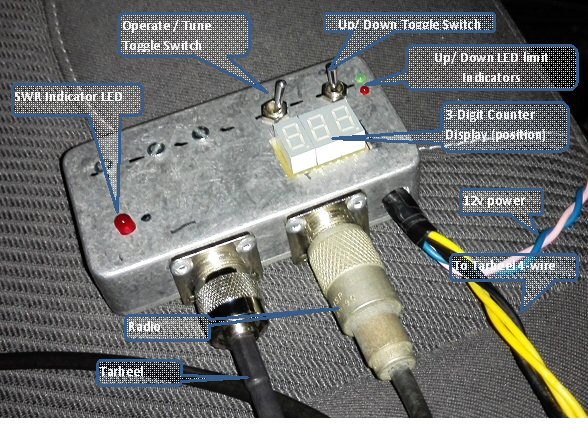
    What is very useful though is a watt-meter or a SWR-meter, and maybe a turns-counter. So after using the antenna for a few days I started checking the possibilities and I built a prototype of a combination box with:

    1. Up / Down switch (to replace the factory-supplied one)
    2. SWR Bridge / meter / indicator
    3. Counter (counts how much of the coil sticks out)

    It is working very well and I will make more details available as I find time to make drawings and test and improve the design.

  • QRSS on 30m with Arduino

    QRSS on Arduino
    QRSS on Arduino
    QRSS is not something I knew anything about, until I stumbled across a useful use for my Arduino: A small daughter board (called a shield) with a few components to turn it into a QRSS transmitter.

    I admit I am lazy and morse code is way out of my reach – know the joke? did it once and didn’t like it? Similarly I had never heard a QRSS signal until I built and tested my module. But once it was up and running I started to become a little more interested in trying to decipher the morse code. And once that got going, I couldn’t help but try to listen out for other QRSS callsigns.

    There is a lot of information on QRSS on the internet, so I will only comment on my own experiences. Firstly, the kit was easy to build.

  • Mobile in Hibberdene KF59gk

    Hibberdene KF59gk 11 Oct 2014a
    Hibberdene KF59gk 11 Oct 2014a
    I had the privilege to go on holiday for a few days to the coast, staying in a lovely woodenframe cottage with my dogs for 4 days. My wife allowed me to pack a small radio, and so on the Saturday I managed to catch a few contacts with my new/old (that’s another story!) IC-703, from the balcony of the cottage overlooking the Indian Ocean in Hibberdene Grid Square KF59gk, kindly rented from Walter and Louise, Hibberdene Escape. They come highly recommended.

    Initially I called ZS5GS and Gerald came booking back 59+ and gave me a 55, with which I was very happy because I was using a short ICOM AH-703 antenna, a portable multibander with a total length of 1.4 meters (4.6 ft)! Incredible performance for such a small device. I also had a similar report back from Johan ZS6AF.

    Thanks guys, you made my day! 73s.