Category: SDR

  • The Great South African G90 2021 Tour

    I used to own a Yaesu FT-857D, three of them, in fact. With them I made all sorts of contacts: straight contacts, QRP digital contacts, mobile FM contacts, and they even pushed my FL2100Z amplifier to full output when I needed to. I loved them and trusted them. While the screen might have been a little small for my older eyes, the radios never ever let me down. I still miss them a lot.

    But times are moving on and instead of following the way of the FT-101 and other dinosaurs (don’t get me wrong: They were excellent radios) I wanted to get some first hand experience of the more current SDR radio trends. First I bought a mcHF portable 5 watt radio which was a great buy and I’ll talk about that more in another post, but then I wanted to but a really “complete” radio for the bush. Smaller than the FT-857 but bigger than the mcHF and an all-rounder. The dice was rolled and fell on the Xiegu G90 which arrived in my shack a few weeks ago. While we can discuss all the details at length in other posts, this post is to let it travel around the country and experience different operators and conditions and antennas.

    Thus, the idea of “The Great South African G90 2021 Tour” was born. I decided to let my baby go visit some new places. My ICOM 7100 will have to do backup duty in the shack while the baby is travelling.

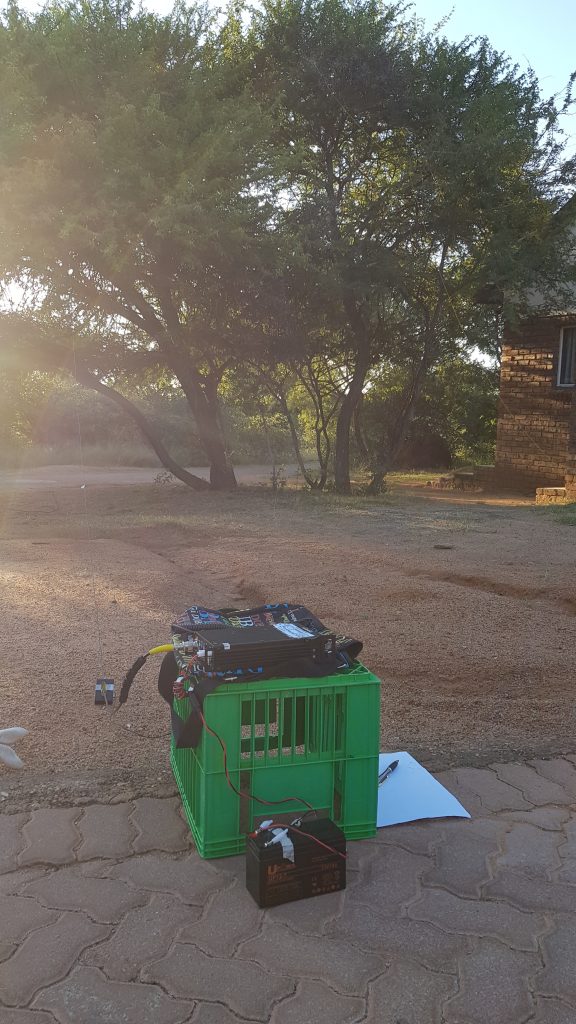
    First stop of the tour was my bush camp. I took my Xiegu G90 on a week long tour to the bush in Dikhololo (north of Brits and Hartebeespoort Dam). I have to admit it was a lot of fun to operate, even though the noise levels were appalling and in many cases made operating impossible on a particular spot.

    In summary I was very happy with it. It is not a big radio but it can stand its own.

  • The QCX – a Nifty Little Gadget

    QCX
    QCX
    So yesterday (it was a Sunday) I had a lot to do, but nothing more important than to cut open the wrappings of the 20m QCX kit that I purchased from QRP-Labs a few months ago. Yes, it was still lying in its protective wrappings after all this time. Work is seriously interfering with my hobbies.

    At first when I shook out all the packets with all the little parts into a tray (standard practise), it was a little intimidating. It wasn’t just a small Ultimate3S kit which I can build with my eyes closed in less than an hour. Instead of taking shortcuts (which the documentation warns against) I decided to follow the manual. That in itself was the best advice ever – the 138 page manual is clear and laid out in logical order.

    I did take a few shortcuts, purely because I have one of those cute assembly rigs where you can insert the components, hold then in place with a foam block, then flip it over to solder all the leads at once. I did all the caps in the first round, and all the resistors second round. I have a habit of checking each solder joint when I snip the wire and in this case the unit worked first time.

    The slowest part of the construction was the toroids. Not because it is difficult, but because my eyes are not so good any more and I have to work under the magnifying light which restricts movement a little. Each one of the 8 wires must be inserted in the correct hole with a tweezer or small longnose.

    My PCB is a version 1 so I did the two recommended modifications.

    All-in-all a very viable kit and very enjoyable to build and use. I particularly liked the idea of the little microswitch “hand-pump” which gave me no end of giggles.

  • No Sound from my SDR

    PSDR
    PSDR
    And in other news, I’m trying to play with this cute little SDR receiver (the cuteness which I am sharing with you in another post), but I’m having mega problems.

    Don’t get me wrong: The issue is not SDR or this cute little Rx. I own and operate a Flex-1500 which has quietly become my almost all-time favourite desktop radio. Software Defined Radios are just awesome. I can install Virtual Audio Cables and serial port replicators and connectors in all the configurations I’m using. I have also played extensively with other variations of hardware kits over time and I would like to think that I’m not an expert but that I can make successful contacts with a SDR.

    Thus, when I needed to squeeze an experimental (not top-of-the-line) and not very good (yet) but definitely tiny (as in physically small) receiver into my Ultimate 3S beacon from Hans Summers over at QRP-Labs, I bought a PSDR module from my friend Anton Janovsky over at Giga. Measuring a fractional 30mm x 40mm the size was exactly right, and it requires a 12v input which I already feed to the Ultimate 3S so that wasn’t going to be a problem. The receiver itself wasn’t going to win any awards for noise or quality, the circuit is a simple Johnson counter with 7474 circuit group and Tayloe detector circuits – more info over at Pandatron. No filters or pre-selection or anything, but good enough for a proof of concept prototype. I might even use the pre-existing LPF filters with a bit of cutting and soldering to the boards.

    The really exciting thing is that in the latest Ultimate 3S from QRP-Labs with the Si5351A synthesizer, it is a piece of cake to tap another output from the frequency generator and use that as the LO (Local Oscillator) input to the PSDR module. A very elegant solution emerges! Forge ahead and spend the money!

    Coming home and temporally connecting it to an AD9851 DDS Function Signal Generator (also from Anton at Giga) and using my trusty Lenovo ThinkPad in the shack, I can’t decipher anything. Really? Nothing.

    To cut a long story short the issue is that the modern laptops don’t have stereo (yes, two channel) inputs. Google it and sift through the millions of hits. The best summary I found was at temporaryland dated 2008 over at his website of rm42 called “Consumer alert – Sound-Mix intentionally crippled laptops” in which he explains that for reasons that makes no sense, modern laptops can only record in MONO from their built-in sound cards. And in the case of Lenovo, maybe they are scared of the DRM police, but they made it a HARDWARE limitation.

    This is important to me, as the PSDR gives out I/Q signals similar to just about any other experimental SDR kit, it needs TWO signals to the processor. Ultimately (pun intended) in the Ultimate 3S I was going to consider using the Analogue inputs’ A/D converter to pick up the sounds for me although I’m not there yet in the design.

    But to hit the wall so early with such a silly limitation is simply stupid. There is a work-around – buy an external USB sound card like the STLab M330 (only 16 bits). But that is an unnecessary expense and extra wires to plug in and extra things that can go wrong. Needless to say, I’m no longer a Lenovo fan.

    So the point of this message is: For the moment, if you want to play with I/Q signals from a SDR receiver, make sure you have a stereo line input. From there, SDRSharp will make your life easy. But without the underlying hardware you are screwed.

    Let me know what you did as a work-around.

  • WSPRing is addictive

    WSPR on 2m
    WSPR on 2m
    Like the mermaid calling the sailor, this mode called WSPR seems to be calling me back every time. Circumstances pushed me out of the house into my new outside semi-underground shack which made me QRT for a while while I was painting and renovating, but the first thing I did (after making the few compulsary voice contacts on 40m) was to set up my WSPR station again.

    But this time it came with a different urgency. After getting the basics right and decoding a few stations on 10m (wow the bands are lively!) I tried 6m. My antenna isn’t very good but what the heck the Flex-1500 can go there. No decodes. Can it go higher? Nope, that is the highest frequency the Flex will do.

    Thus out comes the old trusty Yaesu FT-857D, still a remarkable and reliable radio after so many years, a true benchmark model to compare against. The G4ZLP modem is also the best money I ever spent for first-time-lucky set-ups. But oh dear, nobody on 6m (lots on 10m), so we tune up to 2 meters on a nice vertical. Still no decides, sigh. After reading a bit more, it seems like not a lot of people are WSPRing on 2m and so I posted in the SARL forum as well for some help. Tropo ducting is rife at the coast and my always-opportunistic self decides to make 2m a priority.

    As of this morning my station is QRV on 144.489MHz (dial setting) and I’m in and out of the shack doing chores while thinking about the next step. I’m going to have to wake-up shake-up some rusty old hams to participate otherwise I’ll get no spots. I’ll keep you posted.

    P.S. the upshot of this all is that I spoke to the minister of home affairs about how far we can bend the budget and she agreed that we have enough to buy one of Hans Summers’ Ultimate U3S QRP kits. I’m so excited I can eat raw popcorn!

  • Falklands is a mere WSPR away

    WSPR to Falklands
    WSPR to Falklands

    The last thing I did last night was to make peace between my laptop, my Flex-1500 SDR, and the various VAC and VSP drivers and whatever else was struggling to co-exist in the apparently too small memory of my Windows 7 computer.

    So can you imagine the delightful surprise I got this morning: I switched everything on and went to make coffee and shower. A little bit later I went to check on my WSPR installation, and this is what I saw on the log:

    2015-06-08 05:12 VP8ALJ 3.594094 -19 0 GD18bh 10 ZR6LU KG43 7517 105

    I’m very pleased, because my antenna is not really made for 80m (it’s actually a 40m travelling wave Broadgun) and I wasn’t expecting any spots yet. But there it is, and more than once. Nice spot!

    This is what makes this hobby so great, these little achievements.

  • Flex-1500 – Starting the SDR journey

    Flex-1500 SDR
    Flex-1500 SDR
    I might be older, but I’m very young at heart when it comes to technology. I love playing with all the latest gadgets and adopting my hobby to the emerging technologies. One example would be that I only run solid-state amplifiers (watch out for my series of articles on building my own). I also talk WSPR and digital modes fluently.

    So it would come as no surprise that I tested one of the RTL-2832 USB adapters to see what I could see. And I saw the incredible power of the panadapter display and waterfall combined, and I started thinking. I had to think, because my Minister-Of-Home-Affairs is always asking me why I need another radio since I can only talk on one radio at one time. Doesn’t she understand boys and their toys? Anyhow, I started realising that there are many options out there – most completely out of my range. Sigh.

    Thus, when Hans ZS6KR placed an ad on the swopshop for a second-user Flex-1500 I called immediately and snared myself one of these beauties. I’ve owned it for less than 24 hours, yet it has charmed me in more ways than I can imagine. The receiver (and I mean right up to the display) is incredible. And the 5 watts is a non-issue because my HLA-300V took to the radio like a duck to water, putting out a nice 50-80 watts into the antenna wires.

    I cannot predict where this love-journey will end. All I know is that suddenly a whole new world was opened to me. Yes, it might be the entry-level SDR receiver and already four or five years old, but it has everything necessary to keep me feeling warm and fuzzy during the upcoming winter months.

    I’ll keep you posted. 73s.