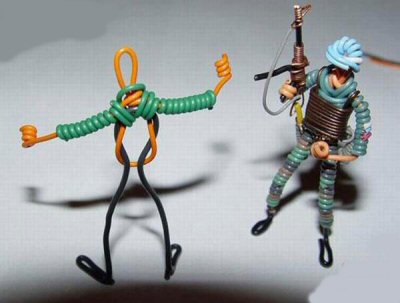
Ham Radio Operators do it with more frequency and less resistance.
And:
Three guys in a car: A mechanical engineer, a Ham Radio operator and a MicroSoft employee are on their way to a meeting when suddenly the car in which they were riding breaks down.
“It’s probably the cable that opens the valve on the carb has come loose, pop the hood and I’ll have us back on the road in no time.” quipped the mechanical engineer.
“I doubt it,” replied the Ham Radio operator, “It has been observed that 83.2 % of similar failures result from the distributor contacts becoming corroded or misaligned, I’ll clean the contacts and we’ll be on our way.”
“No, no, no!” cried the MicroSoft employee: “This car is equipped with a state of the art computer, what we need to do is turn the key off, all get completely out of the car, then get back in and it should start like normal.”
Antenna SprayThe ultimate solution to HIGH SWR! Just use a can of this spray and all your problems will disappear!
I couldn’t help but smile and re-post this picture. I have no idea who the original author is, and I will fully acknowledge him/her if they let me know. I saw the picture for the first time on facebook on the page of David Lowe.
Just proves we are not a bunch of boring old timers, we do have a sense of humour!
88.5Hz Tone GeneratorJay my old Yaesu FT-480R is now operational on tone-protected repeaters! (Ed: Almost!)
From my bad location deep in the pits of Sandton I can just reach the Sandton repeater (145.700) up on the water tower near Wm Nicol Drive if I look north, and if I look south I can definitely reach the ZS6TJ repeater (145.650) on the Carlton Centre. The latter is a very convenient repeater for me to use as it will put me in contact with most of the people I need to talk to from my home QTH. The only problem is they were forced to put a 88.5Hz CTCSS sub-tone on the repeater because otherwise it was prone to false triggering.
And the problem is that my old FT-480R was built in the early 80’s, before the days of CTCSS. However Yaesu had the foresight to put a little connector at the back of the radio where a 35mV signal can be injected (in addition to a burst, but the two signals are paralleled) together with a convenient PTT signal marked 13.6volt. So the search was on for a CTCSS tone generator. I didn’t even bother to look for an original part as the radio is very old, although Yaesu makes mention of a FTS-63E device that should fit the radio.
It didn’t take me long to discover that OM Thys Maree ZS6MJM in Pretoria is building some excellent tone generator boards for the Magalies Club ZS6MRK. Very small and compact, it requires a 5-12v in and puts out a perfect tone that can be level-adjusted. On the bench it immediately gave me a beautiful tone, I adjusted the level and proceeded to install it in an open space in the radio cabinet. Fortunately the FT-480R has a bump on the bottom for the speaker, and there in the corner was a perfect hiding spot for the board.
I haven’t been able to trigger the repeater yet because I soon discovered that the power to the board was not 13.6v as the diagram says, and I suspect a loose connection or something. Nevertheless, I can highly recommend this little board as an add-on to an older rig as it has all the ingredients of a “Life-Extender” for older radios.
My back wallWell, I had to do this: Take a picture of my back wall, to explain how bad my QTH is located. In this view I am looking at the back walls of my neighbours 2 or 3 houses up. The river is on the right, and the power line on my left. The red arrow is where I will be standing for my next photo. River ViewIn the next photo I walked out my back yard towards the river, I turned around, and this is what I can see.
I am standing under a 88kV line, I can see the second line in the left of this picture, and I can barely make out my DSTV dish and the silver of my 2m CP22E antenna. All my antennas are just about halfway up the trees and a third up on the towers.
I have no chance to get a signal out, especially in summer when the trees have leaves.
To add to my frustration I am at the lowest point in the area. The municipal storm water drains are next to my erf, and my altitude is around xxxx MASL. Compare that to Sandton City, about 2km away as the crow flies, which is at xxxx MASL.
Vertical CP22E 2mSo, another sprout is springing up! This latest picture taken late on Friday afternoon, minutes after installation, shows my somewhat unsuccessful attempt to work VHF/UHF from my QTH. It is a 2m vertical (Diamond CP22E) that has 2 x 5/8 elements on top of each other. It claims a gain of 6.5dB and I must admit the build quality is very good. All the bits were in the box, so to speak, and it took me less than 30 minutes to mount.
The rest of the picture of the chimney shows my 2 SAT TV dishes, high up is the BroadGun Travelling Wave wire dipole, below that is the G5RV, and the 83m loop also passes through the view somewhere.
The BroadGun Travelling Wave wire dipole gives good results from 80m-10m at 100 watts and is almost permanently connected to my FT-840 for digital work. Depending on some random factors the loop gives slightly better results but not often.
The G5RV (in spite of the fact that it is standard and hasn’t been upgraded to the ZS6BKW specs) works extremely well. If I pull it up a little higher, or drop it a little lower, it just goes deaf! Exactly why I don’t know, but in this position it works very well and on voice I’m sometimes pumping a few extra watts through it – no problem.
The 83m horizontal loop is just strung from the trees and is interesting, it resonates on almost anything down to 6m. It is quieter that the G5RV and occasionally it is easier to work with.
But yes, the 2m vertical still doesn’t work. Connected to 15m of RG213 and mounted as high as it is I can just, but just, trigger the nearest repeater (Sandton). Simplex is just not possible as I am in a deep hole here and my signal just wafts over everybody’s heads (or antennas to be precise).
Audio boardOM Doug Defty ZS1DUG from the Cape asked me what software and hardware I use to interface my Yaesu FT-857D and this is the reply I sent him:
Hello Doug, hows the Cape!
Lets tackle the software first: I started using Ham Radio Deluxe as my main package this past weekend. The main reason is the handling of the logbook. I want to start collecting some awards, and it feels like HRD is going to do it for me. However I played with many packages before making a decision: fldigi, DXLab and a few others. To be honest, I’m keeping all of them on my laptop because each one does something special that I like. What I am saying is, my contest logbook is from now on going to be on HRD. The rest is for playing. DXLab had a very easy way to monitor HF beacons, which I loved. fldigi on the other hand was great to sort out my cables with and watch the waterfall display. There are other nice programs too, you should try them all and keep the one that works for you.
The hardware followed an equally diverse route. I have two radios (FT-857D and FT-840) and thus I needed two setups. Eventually I realised it was over the top to build so many cables, but I like experimenting. Now, you need two cables per radio: 1= audio, 2=radio control.
(1) The audio to and from the radio into your PC can easily become contaminated with RF and hum loops, therefore you need to isolate the signals with small audio transformers. I bought one board from Jaco ZS6PX and it was almost identical to the one I bought from Phillip ZS6PVT, Essentially it is a matchbox-sized device with two isolation transformers and a capacitor/resistor or two. The transformers we buy from Communica for a few rands, see my picture attached. This one also has a PTT circuit onboard, but of course the Yaesu can PTT through the CAT cable and I don’t use the PTT on my radio. Total cost for an audio interface is R50 or so if you build it yourself.
(2) The radio-control cable (CAT in Yaesu language) is a little more complicated, although not terribly so. I am going to include a HRD manual for your perusal that I found on the internet and it has a few diagrams. You have to do level-shifting from 0-5volt to +/- 12volt. The hardest part is finding a board to simplify your construction. Basically there are 2 ways to interface: you either use a MAX232 chip, or you use a few transistors. I’ve tried both and they work. I even built the “tini-cat” circuit diagram that I found on the internet. Notice though the generous use of little ferrite rings everywhere to kill RF interference. The photo shows the board I purchased from Jaco ZS6PX (transistors) and Phillip ZS6PVT makes a chip one. Both work very well. Built-up they can cost you a little bit, but if you are handy with a soldering iron you can do it yourself. My first one I built for nothing, stripping an old CB radio for parts!
RS232 board
NB NOTE: Just remember, the boards you build yourself are Serial (RS232) interfaces. Modern computers don’t have serial ports any more, so you should have an additional USB-to-Serial converter cable handy. This adds around R100 to your budget if you have to buy it.
(3) While we are on the topic of expanding your radio, I want to mention that I also built an external S-Meter for my 857, the hardest part was to print the new scale to stick onto the existing dial.
(4) My final add-on is a small board that I bought from Vivian ZS6VD. You plug it into your mic cable, and you use a PC Headset as a mic-and-headset combination. Quality very good and it took me an hour to build. Now I can operate silently at night while the family is asleep..
Doug, I was ecstatic when I was first able to control my rig from my PC, and so I wish you luck with your project. Don’t hesitate to contact me for more info. I’m putting this email on my website also.
Digital TestWow what an exciting weekend! Greatly inspired by Noel Hammond (ZR6DX) during his talk at the West Rand Amateur Radio Club, I put together a few items that have been gathering dust in my junkbox. Being late in the day I didn’t expect anybody to be around, so I sneaked a quick CQ on what I thought was an empty piece on the 20m band just to see if everything was working and if there is something going out on the wires.
Well, you can imagine my excitement when ZR6AOC (David Cloete from just up the road in Weltevreden Park) replied. My hands were shaking, I didn’t have any macros loaded to assist me, and I didn’t even know how many watts or splattering I was emitting! But I couldn’t resist and I replied.
To my horror David came back! He wasn’t joking! Its working! We had a nice if short QSO, he even gave me a good 599 report. I think I forgot to breathe. The result is that I am hooked on digital. As you can see from the photo the electronics wasn’t built into a case yet, but shortly afterwards they were all neatly tucked into a box and by the end of the weekend I made 10 contacts and 6 countries. Awesome stuff!
BTW I’m setting up the Yaesu FT-840 permanently as a digital station so I don’t have to swop cables, and it is going out on a Broadgun Travelling Wave antenna (from Webb Industries, a multiband inverted Vee wire). All my contacts so far have been around 50 watts.
Don’t hesitate to give me a call sometime, I would love to make contact with you!