Initially I used a standard 108″ whip antenna, tuned with a tuner. I bolted it to my towbar with a custom bracket. It kind-of works but deep inside I had the feeling I should try something else.
Then I played with an Alpha Moto Mobile Antenna (all-bander) that I purchased from Ivan Marks in Cape Town, together with a Alpha Stainless Steel Quick Release Jaw Clamp Mount. The jaw clamp is awesome and will stay in my toolbox. The antenna worked well from 20/15/10 but it was – as can be expected – a few points down on 40m. Interesting antenna though.
But eventually I scraped together enough money to lay out for a Little Tarheel II from Sams Radio Accessories. It was both very expensive, and a complete and utter technical surprise at the same time. While I still think I paid far too much for a simple antenna (cough-cough), it is the design and installation that is most intriguing.
Firstly, I was wrong. I did not understand how a screwdriver antenna works, and I’m not talking about the engineering. I nearly added another G to the purchase to buy a controller. Boy, was I lucky that the item wasn’t in stock! See, the issue is that the Tarheel doesn’t need a tuner – it is for all practical purposes a tuner in itself. Nobody tells you that when they talk about the antenna.
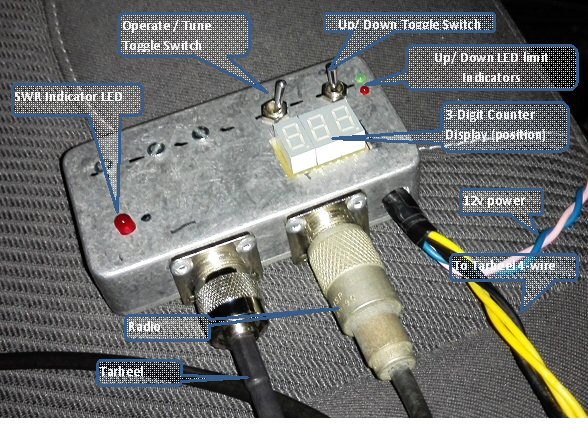
What is very useful though is a watt-meter or a SWR-meter, and maybe a turns-counter. So after using the antenna for a few days I started checking the possibilities and I built a prototype of a combination box with:
- Up / Down switch (to replace the factory-supplied one)
- SWR Bridge / meter / indicator
- Counter (counts how much of the coil sticks out)
It is working very well and I will make more details available as I find time to make drawings and test and improve the design.
